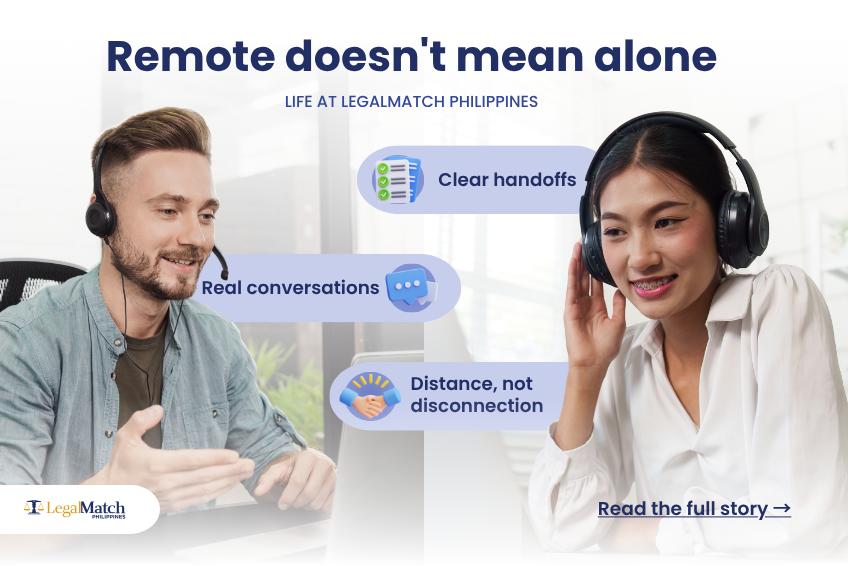
Remote Doesn’t Mean Alone at LegalMatch PH

Remote Doesn’t Mean Alone at LegalMatch PH

Ask anyone new to remote work the same question, and it usually comes up: “isn’t it lonely?” Fair question. But talk to the team at LegalMatch Philippines, and the answer tends to surprise people — for many, working across time zones has meant feeling more connected, not less. 

Time Zones Aren’t a Wall, They’re a Handoff 

Working across Philippine and US hours could easily mean two teams passing like ships in the night. Instead, it’s turned into something closer to a relay — one person wraps up their day with a clear note on where things stand, and the next picks it up without missing a beat. There’s a rhythm to it once a team finds it, and it means no one’s stuck waiting on a reply at 2am just to keep moving. 

Small Moments Add Up 

What actually keeps a remote team from feeling scattered isn’t a fancy tool — it’s the small, deliberate habits. A quick voice note instead of a wall of text. Someone remembering to ask how the weekend went before diving into the agenda. Team chats that aren’t just status updates but actual conversations. None of it is mandated; it’s simply how the culture has evolved, one ordinary interaction at a time. 

That’s often what surprises people moving into legal tech from a more traditional office setup — connection here isn’t something bolted on through mandatory fun. It shows up in the everyday rhythm of how people choose to work together, even from a distance. 

Distance, Not Disconnection 

For anyone eyeing remote legal jobs in the Philippines and wondering if it means working in isolation, the honest answer is: it depends entirely on the team. At LegalMatch, distance has become more of a detail than a barrier — which, at a company built on connecting people to the right help across a legal marketplace, tracks more than one might expect.
The Year “Trying It” Became “Using It”

The Year “Trying It” Became “Using It”

Last year, a lot of legal teams were still testing the waters with AI — poking at a new tool here, running a pilot there. That phase is over. The real question now isn’t whether legal teams use AI, it’s whether that usage is actually making a difference. That shift changes everything about how we build. 

What Changes When Adoption Becomes the Baseline 

When a feature is new, the goal is simple: does it work? When it’s already part of daily use, the bar moves. Engineers stop asking “can this be built” and start asking “does this actually save someone time, reduce errors, or make a real case easier to manage.” That’s a harder, more interesting problem — and it’s the one our team is solving for right now. 

It also means paying closer attention to the parts of AI that don’t get talked about in demos. Reliability matters more once people depend on a tool daily. Trust matters more once decisions ride on what a system surfaces. Our engineering and QA teams spend real time thinking about accuracy and edge cases — not because it’s exciting work, but because it’s the work that determines whether a tool earns a place in someone’s actual workflow. 

Building for People Who’ve Moved Past Curiosity 

The users on the other end of our platform aren’t experimenting anymore — they’re relying on it to do their jobs well. That’s a meaningful responsibility, and honestly, a motivating one. It means the wins on our team don’t look like a flashy new feature launch. They look like a workflow that got a little faster, a search that returned a better match, a process that quietly got easier for someone who needed it to. 

Why This Moment Is Exciting to Build In 

This is the part of legal tech that doesn’t always make headlines, but it’s where the real progress happens — the unglamorous, detail-oriented work of turning a good idea into something people can genuinely count on. For engineers, QA, and product folks who like solving problems that matter, this shift from adoption to impact is exactly the kind of challenge worth signing up for.